

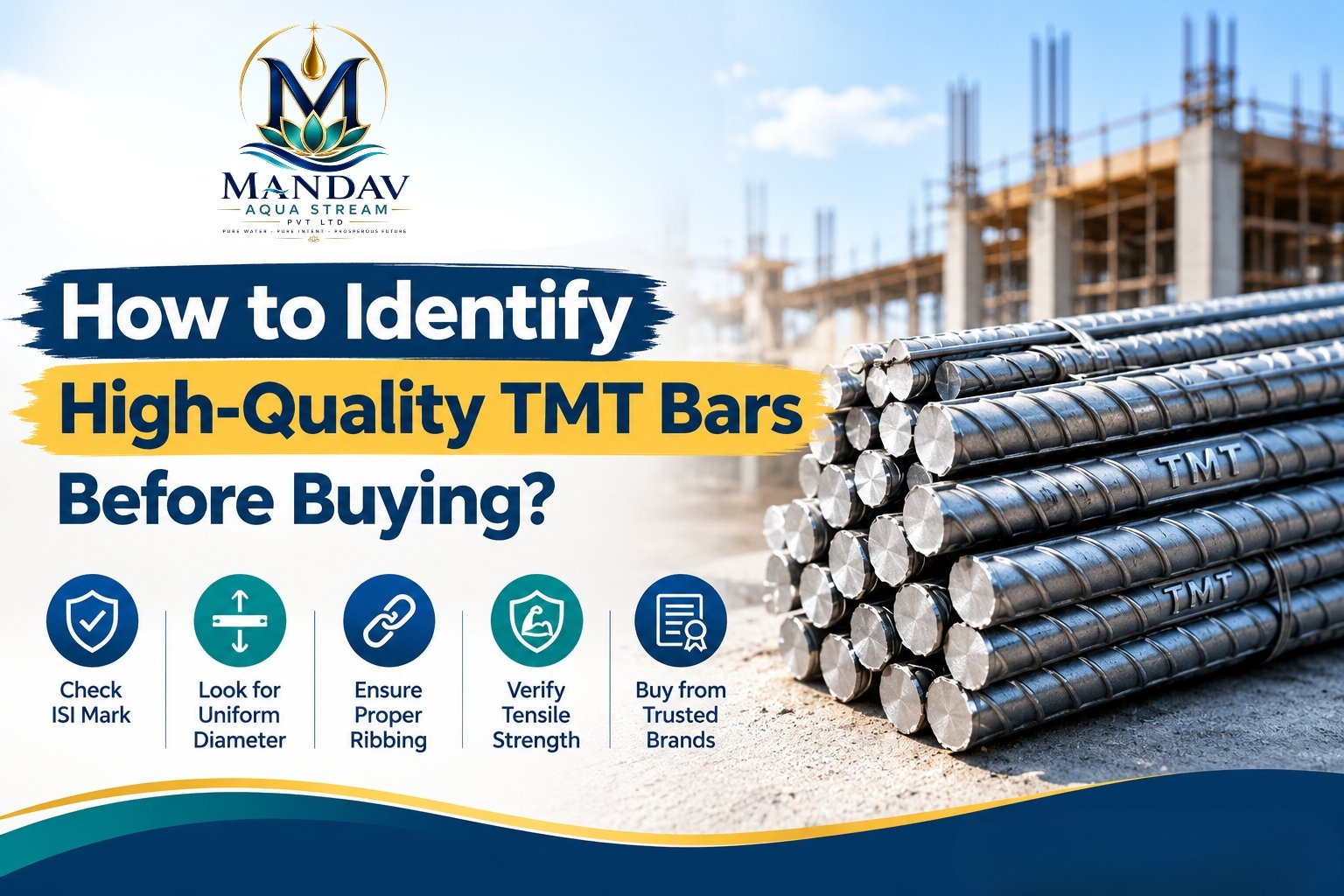



Choosing the right TMT Bars is an important step in building a strong, durable, and safe structure. Whether you are constructing a house, commercial building, bridge, or industrial facility, the quality of reinforcement steel directly affects the strength of reinforced cement concrete (RCC). However, comparing brands, grades, prices, and technical specifications can be confusing for buyers. Understanding how to check TMT Bars before buying helps you make an informed decision, avoid substandard materials, and select steel that meets your project’s requirements.
For builders, contractors, engineers, and individual homeowners, the goal should be to choose reinforcement bars that meet applicable quality standards rather than simply purchasing the cheapest option. This guide explains the essential checks, quality indicators, and buying considerations to help you identify high-quality TMT Bars for your construction project.
What Makes TMT Bars High Quality for Construction?
TMT stands for Thermo-Mechanically Treated. These steel bars undergo a controlled manufacturing process involving high-temperature rolling, rapid surface cooling, and subsequent self-tempering. This process creates a strong outer layer while maintaining a relatively ductile inner core.
High-quality TMT Bars combine strength, flexibility, weldability where specified, and suitable bonding with concrete. These characteristics help reinforced concrete structures withstand everyday loads and various environmental stresses when the bars are correctly selected and installed.
The quality of a TMT bar depends on several factors, including:
- Mechanical properties: Tensile strength, yield strength, and elongation.
- Chemical composition: Controlled levels of carbon, sulphur, phosphorus, and other elements.
- Manufacturing consistency: Uniform dimensions, rib patterns, and material properties.
- Corrosion resistance: Appropriate performance for the intended exposure conditions.
- Quality certification: Compliance with relevant Indian Standards and applicable requirements.
No single visual feature can confirm all these properties. Buyers should combine a physical inspection with documentation and, where necessary, independent testing.
7 Essential Checks Before Buying TMT Bars
Before placing an order, inspect the product and verify its specifications. The following checks can help you distinguish reliable reinforcement steel from material that requires further investigation.
1. Verify BIS Certification and IS 1786 Compliance
One of the first steps is to verify whether the TMT Bars meet the applicable Indian Standard for high-strength deformed steel bars and wires used for concrete reinforcement, IS 1786.
Check the manufacturer’s details, relevant BIS Standard Mark, licence information, and grade specifications. Do not rely only on a printed logo or a seller’s verbal assurance. Verify the licence and its current status through official Bureau of Indian Standards resources.
The documentation should match the actual manufacturer and product supplied. If the information appears inconsistent, ask the supplier for clarification before making a purchase.
2. Check the TMT Bar Grade and Strength
TMT Bars are available in different grades, including Fe 415, Fe 500, Fe 500D, Fe 550, and Fe 550D. These designations indicate different mechanical property requirements under the applicable standard.
The letter “D” generally denotes a grade with enhanced ductility requirements compared with the corresponding non-D grade. This can be important in structures designed to accommodate deformation, including those subject to seismic demands.
However, a higher grade is not automatically the best choice for every project. The structural engineer should specify the appropriate grade according to the building design, loading conditions, detailing requirements, and applicable codes.
3. Inspect the Surface and Rib Pattern Carefully
The surface of a TMT bar can provide useful clues about its condition. Examine the bars for deep pitting, visible cracks, excessive rust, flaking, unusual bends, or signs of damage caused by improper storage and handling.
Also check the ribs or lugs along the bar. These deformations help the steel bond mechanically with concrete. The rib pattern should appear reasonably consistent with the manufacturer’s product specifications.
Keep in mind that minor surface discoloration or light rust does not automatically mean a bar is defective. The severity of corrosion, any loss of cross-sectional area, and compliance with applicable requirements must be assessed before use.
4. Confirm the Bar Diameter and Weight
The diameter of a TMT bar affects its cross-sectional area and contributes to its load-bearing capacity. A bar that does not meet the specified dimensions or mass requirements may compromise the intended structural design.
Check the nominal diameter against your project’s reinforcement schedule. Common sizes include 8 mm, 10 mm, 12 mm, 16 mm, 20 mm, and 25 mm, although the required sizes depend on the design.
You can also compare the delivered weight with the expected theoretical weight.
The approximate theoretical weight per metre can be calculated using this formula:
| Bar diameter | Approx. theoretical weight per metre |
|---|---|
| 8 mm | 0.395 kg |
| 10 mm | 0.617 kg |
| 12 mm | 0.889 kg |
| 16 mm | 1.580 kg |
| 20 mm | 2.469 kg |
| 25 mm | 3.858 kg |
These figures are approximate reference values. Actual acceptance should follow the applicable standard’s dimensional and mass tolerances rather than an arbitrary comparison with a single measured piece.
5. Ask for Mill Test Certificates
A Mill Test Certificate (MTC) provides important information about the steel supplied. It may include the manufacturer’s details, batch or heat number, grade, chemical composition, and mechanical test results.
Before buying High-Quality TMT Bars, request the relevant certificate and check that the grade and batch information correspond to the material being delivered.
A reliable supplier should be able to explain the available product documentation and help you verify the supplied specifications. For larger construction projects, engineers or quality-control teams may also arrange independent testing through a suitable laboratory.
6. Evaluate Ductility and Other Mechanical Properties
Strength is essential, but reinforcement steel must also exhibit the ductility required by its specified grade and structural application. Ductility allows steel to undergo deformation before fracture, which can be important when structures experience unexpected loading.
Relevant properties include yield strength, tensile strength, elongation, and the tensile-to-yield strength relationship where specified.
These properties cannot be reliably confirmed by simply looking at a bar or bending it by hand. Avoid informal bend tests as the sole proof of quality. Instead, review certified test results and use testing methods prescribed by the relevant standard.
7. Review Storage Conditions and Delivery Quality
Even correctly manufactured TMT Bars can be affected by poor storage and handling. Bars stored directly on wet ground or exposed to persistent moisture may develop corrosion, while rough transportation can cause bending or physical damage.
Before accepting a delivery, check whether the bars are:
- Free from serious corrosion, cracks, and visible damage.
- Consistent with the ordered diameter, grade, and quantity.
- Identifiable through suitable product markings and batch details.
- Stored and transported in conditions that limit contamination and damage.
Document any significant concerns before accepting the material. Ask the supplier or project quality-control team to inspect questionable bars and determine whether they meet the applicable acceptance requirements.
How to Compare the Best TMT Bars for Your Project?
The Best TMT Bars are not necessarily the most expensive or the ones with the highest grade designation. The right product is one that satisfies the project’s engineering requirements, relevant quality standards, durability needs, and budget.
Use the following comparison table when evaluating different suppliers.
| Selection factor | What to check | Why it matters |
|---|---|---|
| Certification | Applicable BIS licence and standard | Supports standards compliance |
| Grade | Engineer-approved grade | Matches design requirements |
| Mechanical properties | Certified test results | Verifies specified performance |
| Dimensions | Nominal diameter and mass | Supports reinforcement accuracy |
| Surface condition | Corrosion and physical damage | Helps identify material concerns |
| Traceability | Manufacturer and batch details | Supports verification and quality control |
| Supply reliability | Availability and delivery schedule | Helps avoid construction delays |
| Commercial terms | Price, taxes, freight, and payment terms | Enables fair supplier comparison |
Compare products on the same specifications rather than choosing based on a brand name or price alone. For structural work, the project engineer should approve the material before it is incorporated into the reinforcement.
What Factors Affect High-Quality TMT Bars Cost?
The High-Quality TMT Bars Cost depends on several market, manufacturing, and project-related factors. Comparing quotations carefully helps buyers understand the value offered by each supplier instead of focusing only on the lowest price.
The main factors affecting TMT bar prices include:
- Steel market rates: Changes in raw material costs, production expenses, and market demand influence selling prices.
- Bar grade and specifications: Different grades and technical requirements may affect product pricing.
- Bar diameter and quantity: The required sizes and total order volume influence the overall purchase cost.
- Brand and quality assurance: Manufacturing consistency, certification, and traceability contribute to the value of the supplied material.
- Transportation and delivery: Freight charges, delivery distance, and unloading arrangements can change the final cost.
- Taxes and commercial terms: GST, payment conditions, and other applicable charges should be considered when comparing quotations.
Request an itemised quotation that specifies the grade, diameter, price per kilogram or tonne, applicable taxes, freight, and delivery terms. This makes it easier to compare suppliers on a like-for-like basis.
Remember that selecting cheaper steel without checking its compliance and quality can create avoidable risks. A better buying decision balances price, verified specifications, and dependable supply.
Common Mistakes to Avoid When Buying TMT Bars
Even experienced buyers can overlook important checks when ordering reinforcement steel. Avoid these common mistakes to improve purchasing decisions and material control.
Choosing steel based only on price: A low quotation should not replace verification of grade, certification, and test documentation.
Assuming all grades are interchangeable: Each grade has specific mechanical properties. Substituting one grade for another without engineering approval can affect the structural design.
Ignoring the manufacturer’s identity: Unclear branding, inconsistent markings, or missing batch information can make verification difficult.
Relying on visual inspection alone: A clean surface does not prove that steel meets the required mechanical and chemical properties.
Overlooking storage conditions: Poor storage may expose reinforcement bars to moisture, contamination, and avoidable damage.
Ordering without confirming specifications: Verify diameters, grades, quantities, delivery schedules, and documentation before finalising the purchase.
A consistent inspection and documentation process helps builders, contractors, and procurement teams reduce the risk of receiving unsuitable materials.
Why Choose a Reliable Supplier for TMT Bars?
A dependable supplier helps simplify material procurement by providing clear product information, consistent communication, and reliable delivery coordination. This is particularly important for projects where material availability and quality checks influence construction schedules.
Mandav Aqua Stream Pvt Ltd. brings over 30 years of industry experience and has supplied products across more than 28 regions, supporting over 300 projects or clients. The company focuses on pipeline products for water supply, sewage, irrigation, industrial, and infrastructure applications.
When sourcing reinforcement steel or other construction materials, buyers should confirm the supplier’s actual product range, relevant certifications, and ability to provide the specifications required for their project. Clear documentation and dependable service can make the procurement process more efficient.
For any TMT bar purchase, insist on material traceability, applicable quality documentation, and specifications approved by your project engineer.
Conclusion: Make a Confident TMT Bar Buying Decision
Identifying High-Quality TMT Bars requires more than checking their appearance or comparing prices. Buyers should verify applicable BIS certification, confirm the grade, inspect the surface, check dimensions and mass, review mill test certificates, and assess storage and delivery conditions.
The right reinforcement steel must meet the structural engineer’s requirements and applicable standards. By following a systematic checklist, homeowners, builders, and contractors can make more informed purchasing decisions and avoid relying on unsupported quality claims.
Planning an infrastructure or construction project? Connect with Mandav Aqua Stream Pvt Ltd. to discuss your pipeline product requirements and sourcing needs. Contact the team to learn more about its product range, quality documentation, and supply solutions for your project.
Frequently Asked Questions
1. How can I identify high-quality TMT Bars?
Check the applicable BIS certification, grade markings, manufacturer details, surface condition, nominal diameter, and mass. Request a Mill Test Certificate to verify chemical composition and mechanical properties against the relevant standard.
2. Which TMT bar grade is best for house construction?
The appropriate grade depends on the structural design, loading conditions, and applicable building codes. Grades such as Fe 500 and Fe 500D are commonly considered for reinforced concrete construction, but your structural engineer should specify the correct grade for your project.
3. Can I check TMT bar quality by bending it?
Bending alone cannot establish overall TMT bar quality. Although bend and rebend tests may be used under prescribed testing procedures, strength, elongation, chemical composition, and other requirements should be verified through suitable documentation and testing.
4. What affects the cost of high-quality TMT Bars?
The cost depends on steel market rates, grade, diameter, order quantity, certification requirements, transportation, taxes, and delivery terms. Compare itemised quotations for equivalent specifications before making a decision.
5. Why is BIS certification important when buying TMT Bars?
BIS certification helps buyers verify that a product is covered by a valid licence for the applicable Indian Standard. Check the licence details through official BIS resources and ensure that the supplied product’s grade and manufacturer information match the documentation.
