
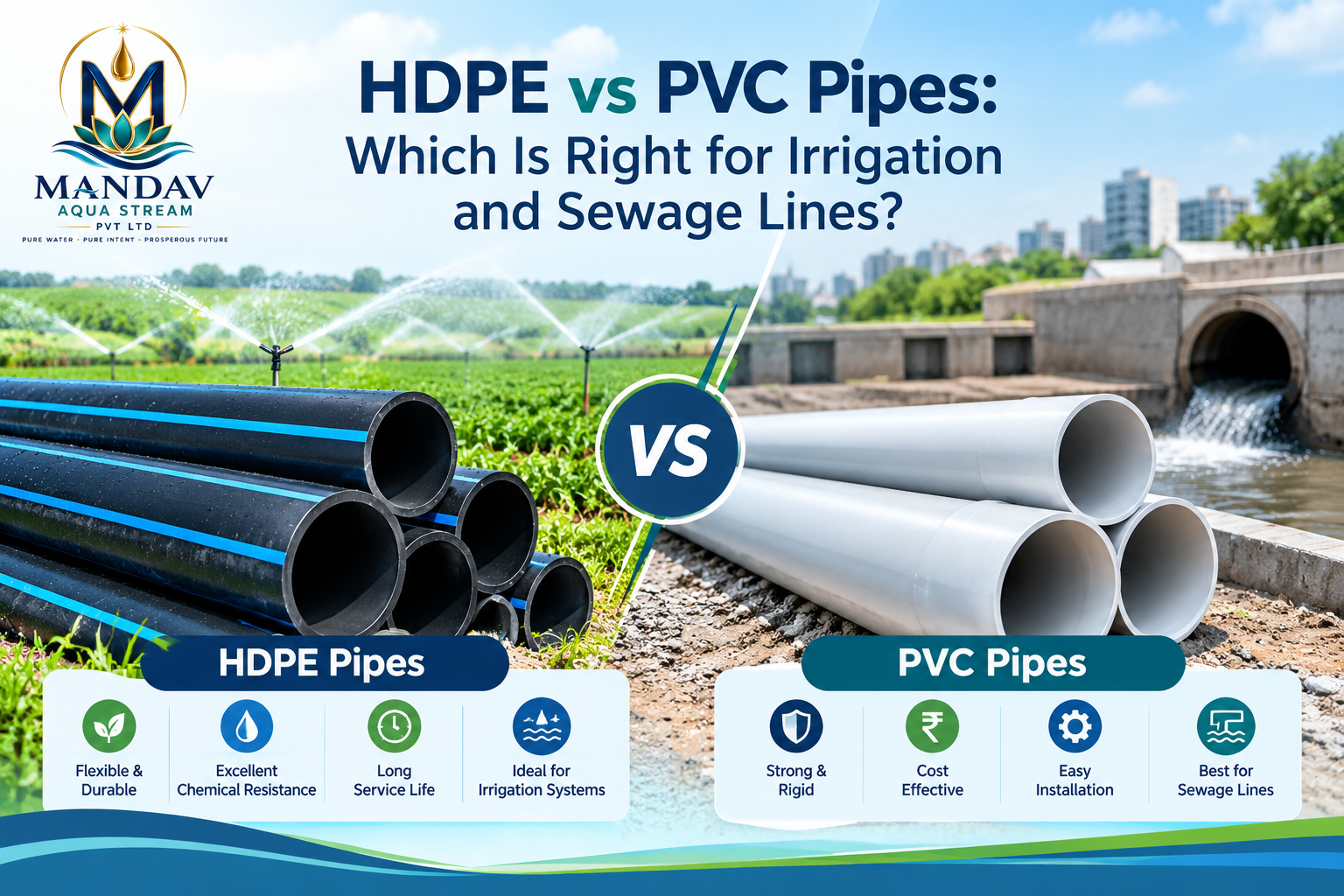
Choosing between HDPE vs PVC Pipes involves more than comparing prices or material names. The right pipe must handle the required water flow, withstand operating pressure, suit the ground conditions, and remain reliable after installation. A pipeline running across an agricultural field has different requirements from an underground sewage network, so the best option depends on how and where the pipes will be used.
HDPE Pipes and PVC Pipes are both widely used in water infrastructure, but they behave differently during installation and operation. HDPE is flexible and can accommodate certain ground movements, while PVC is generally more rigid and can work well in conventional water distribution, drainage, and sewerage systems. Understanding these differences helps you avoid unnecessary installation costs and choose a pipeline that meets your project’s actual needs.
For agricultural, commercial, and infrastructure projects, Mandav Aqua Stream Pvt Ltd. supplies pipeline products for water supply, irrigation, sewage, and industrial applications. This guide explains how HDPE and PVC compare, where each performs well, and what to check before making a purchase.
What Makes HDPE and PVC Pipes Different?
The most important difference lies in the materials themselves. HDPE stands for high-density polyethylene, while PVC stands for polyvinyl chloride. Their material properties influence flexibility, jointing methods, installation requirements, and suitability for different pipeline layouts.
HDPE Pipes: Designed for Flexibility
HDPE Pipes are made from a tough thermoplastic material that can bend within specified limits without behaving like a rigid pipe. This flexibility can be useful when a pipeline passes through uneven terrain, follows a curved route, or encounters moderate ground movement.
Another important feature is the ability to join compatible HDPE pipes through butt fusion or electrofusion. When the process is performed correctly, the joint can form a continuous connection that reduces potential leakage points.
HDPE is commonly considered for agricultural irrigation, underground water distribution, wastewater networks, and certain industrial applications. However, its suitability depends on the pipe grade, pressure rating, temperature, and project specifications.
PVC Pipes: Practical for Fixed Pipeline Layouts
PVC Pipes are generally more rigid than HDPE pipes. This makes them suitable for many fixed pipeline routes where maintaining alignment is important and the ground can be properly prepared.
PVC products are available in different types and specifications for applications such as water supply, irrigation, drainage, and sewerage. Their relatively low weight can make handling easier, while compatible ring-joint or solvent-cement systems can simplify installation.
Not all PVC pipes have the same pressure capacity or intended use. Before selecting one, check whether it is manufactured for pressurised water, gravity drainage, underground sewerage, or another specific application.
HDPE vs PVC Pipes: A Practical Comparison
Both materials can perform reliably when correctly selected. The differences become clearer when you compare the needs of an actual project.
| Factor | HDPE Pipes | PVC Pipes |
|---|---|---|
| Flexibility | Flexible within specified limits | Generally rigid |
| Ground movement | Can accommodate some movement through pipe flexibility | Requires suitable bedding and design for movement |
| Jointing | Commonly fusion-jointed or mechanically connected | Often uses ring joints, solvent cement, or approved fittings |
| Impact resistance | Generally offers good impact resistance | Depends on pipe type, formulation, and specifications |
| Corrosion | Resistant to corrosion | Resistant to corrosion |
| Irrigation | Useful for curved routes and many pressurised systems | Useful for fixed irrigation networks and compatible systems |
| Sewage | Suitable for specified gravity or pressure wastewater systems | Suitable for specified gravity sewerage and drainage systems |
| Installation considerations | Fusion equipment and trained operators may be required | Jointing method and careful bedding depend on the product |
| Selection priority | Flexibility, connection integrity, and site conditions | Rigidity, alignment, and application-specific specifications |
These comparisons describe general characteristics. Actual performance depends on pipe dimensions, material grade, pressure class, installation quality, and the conditions in which the pipeline operates.
Which Pipe Is Better for Agricultural Irrigation?
Irrigation pipelines must deliver the required amount of water without excessive pressure loss or frequent leakage. The choice between HDPE and PVC depends on the irrigation method, field layout, water source, and operating pressure.
When HDPE Pipes Make Sense for Irrigation
Consider HDPE when the pipeline needs to follow a curved route, cross uneven ground, or accommodate some soil movement. Its flexibility can make routing easier in agricultural fields where perfectly straight alignments are difficult to maintain.
HDPE can also be a practical choice for pressurised irrigation systems, including compatible sprinkler and water-distribution networks. Fusion joints can help minimise leakage when installed correctly, which is important where water loss affects operating costs.
For long agricultural pipelines, compare the availability of suitable diameters, fittings, pressure ratings, and installation services before deciding.
When PVC Pipes Make Sense for Irrigation
PVC may be a good option for fixed irrigation layouts where pipelines follow relatively straight routes and stable trench bedding can be provided. It is also worth considering when compatible fittings and installation services are readily available.
For example, a farm with a planned underground water-distribution network may find suitable PVC pressure pipes practical for its layout. The decision should still account for the pump’s operating pressure, pressure surges, soil conditions, and future maintenance access.
Practical tip: Do not choose a pipe based on the pump’s normal pressure alone. Ask the designer to consider maximum operating pressure and potential surges, especially when valves close quickly or pumps start and stop frequently.
Which Pipe Is Better for Underground Sewage Lines?
Sewage pipelines face different challenges from irrigation networks. They may carry wastewater containing suspended solids, remain buried for decades, and experience soil loads, groundwater pressure, or movement around joints.
The first step is to establish whether the project involves gravity sewerage or pressure sewerage. Gravity systems rely on a designed slope to move wastewater, while pressure systems use pumps to transport it.
HDPE Pipes for Sewage Applications
HDPE can be useful in sewage projects where flexible routing, fusion-jointed connections, or trenchless installation methods are important. Properly made fusion joints can reduce the number of conventional joint interfaces along the pipeline.
This may be valuable in locations where leakage control is a priority or excavation is difficult. Nevertheless, the pipe must be designed for the intended wastewater service, burial depth, external loads, and operating conditions.
PVC Pipes for Sewage Applications
Suitable PVC sewer pipes are commonly used in gravity drainage and underground sewerage networks. Their rigidity can help maintain the designed alignment and gradient when the trench, bedding, and surrounding soil provide appropriate support.
For gravity sewerage, correct slope matters because poor alignment can encourage sediment accumulation and blockages. The designer should also consider joint integrity, pipe stiffness, groundwater conditions, and resistance to external loading.
Neither material is automatically the better sewage option. The correct decision depends on the network design, installation method, wastewater characteristics, and applicable standards.
What Should You Check Before Buying Pipes?
A pipe that looks suitable on paper may not meet the project’s operating requirements. Review these factors before requesting a quotation.
1. Pipe Diameter and Required Flow
Determine how much water or wastewater the pipeline must carry. Diameter affects flow velocity, friction losses, and system performance. A qualified designer can calculate the appropriate size for the required flow and route.
2. Pressure Rating and Wall Thickness
For pressurised systems, confirm the pipe’s pressure rating, material grade, dimensions, and temperature limitations. HDPE specifications commonly include the standard dimension ratio (SDR), which relates the outside diameter to wall thickness. PVC products also require the appropriate pressure classification.
3. Soil and Groundwater Conditions
Buried pipelines must withstand external loads as well as internal operating conditions. Consider burial depth, soil type, traffic above the pipeline, groundwater, and the quality of trench bedding.
4. Jointing and Installation Requirements
Compare the complete installation process rather than the pipe alone. HDPE fusion requires suitable equipment and trained operators. PVC installation requirements vary with the connection system, including ring joints or solvent-cement joints where permitted.
5. Product Standards and Intended Use
Check the manufacturer’s documentation, applicable Indian Standards, product markings, and relevant test certificates. Confirm that the selected pipe is intended for irrigation, pressurised water, gravity sewerage, or pressure wastewater service as required.
Does HDPE or PVC Offer Better Long-Term Value?
The lowest purchase price does not always result in the lowest overall project cost. A meaningful comparison should include the pipe, fittings, transport, trenching, jointing, testing, repairs, and expected maintenance.
HDPE may offer better value where its flexibility, fusion connections, or suitability for certain trenchless methods reduces installation complexity. PVC may be economical for conventional networks where standard fittings, familiar jointing methods, and straightforward trenching suit the project.
Service life also depends on operating pressure, temperature, chemical exposure, installation quality, and maintenance. Avoid assuming that one material will always last longer than the other.
When comparing quotations, request prices for equivalent specifications and confirm that each product meets the same functional requirements. This makes the comparison more useful than evaluating price per metre alone.
Choosing the Right Pipeline Supplier
A suitable supplier should help you identify products that match your project’s specifications instead of recommending a material based only on general advantages. Ask about available sizes, pressure ratings, product standards, compatible fittings, delivery schedules, and technical documentation.
Mandav Aqua Stream Pvt Ltd. provides pipeline solutions for water supply, sewage, irrigation, industrial, and infrastructure projects. The company reports more than 30 years of industry experience, 300+ projects or clients, and supply across 28+ regions.
Whether you are planning a farm irrigation network or an underground sewage system, confirm the product specifications and installation requirements before placing an order.
Frequently Asked Questions
1. Are HDPE Pipes better than PVC Pipes for irrigation?
HDPE can be advantageous for curved routes, uneven terrain, and certain pressurised irrigation systems. PVC can work well in fixed layouts with suitable support. The best option depends on pressure, flow, installation conditions, and project costs.
2. Which pipe is better for underground sewage?
Both HDPE and PVC are suitable for specified sewage applications. HDPE may be preferred for some pressure or trenchless installations, while suitable PVC sewer pipes are widely used in gravity networks. Always check the applicable product standard and design requirements.
3. Can HDPE and PVC pipes be connected together?
They can be connected using suitable, compatible transition fittings or approved mechanical connections. They should not be assumed to connect directly, and the connection must meet the system’s pressure, sealing, and application requirements.
4. Which is more cost-effective, HDPE or PVC?
The answer depends on material prices, fittings, installation labour, jointing equipment, transport, and maintenance. Compare complete installed costs using equivalent pipe sizes and performance specifications before deciding.
5. How do I select the correct pipe pressure rating?
Determine the maximum expected operating pressure, including possible surges, and consider temperature, diameter, wall thickness, and the applicable design standard. Consult a qualified pipeline professional or supplier if the requirements are unclear.
Find the Right Pipes for Your Project
The choice between HDPE vs PVC Pipes depends on the job each pipeline must perform. HDPE can be a strong option where flexibility and fusion-jointed connections are beneficial, while PVC is well suited to many fixed water-distribution, drainage, and sewerage networks when correctly specified.
Contact Mandav Aqua Stream Pvt Ltd. to discuss your irrigation or sewage requirements, compare suitable pipe specifications, and identify a solution that meets your project’s performance and budget needs.
